Pages and sections — Findit Next.js
A page is a small file that picks sections and hands them content. src/app/property/page.tsx is the whole Properties
page:
export const metadata: Metadata = pageMeta(routes.properties, { title: content.meta.title, description: content.meta.description });
export default async function PropertiesPage() {  const { groups, cards } = await getPropertyList({ type: "all" }, content);  return (    <>      <PropertiesSection content={content} exploring={content.filter.all} groups={groups} properties={cards} />      <FaqSection content={faq} />    </>  );}
pageMeta(route, meta)gives the page its browser title, description, canonical link and share image.getPropertyList()reads the collections (see Editing the content) and prepares the cards and the filters.- The sections render them.
The sections you can use
Section titled “The sections you can use”In src/components/sections/. Each takes its copy as content and its data as a list.
| Section | Used on |
|---|---|
HomeHeroSection, FeaturedSection, BenefitsSection, CitiesSection, ProcessSection, LatestSection, TestimonialsSection, FactsSection, BlogSection |
Home |
AboutHeroSection, HistorySection, AboutProcessSection, TeamSection, TestimonialsSection, FaqSection |
About |
PropertiesSection, FaqSection |
Properties and the three kinds of filter page |
PropertyMainSection, RelatedSection |
Property details |
AgentsSection, BenefitsSection, LatestSection |
Agents |
AgentMainSection, AgentPropertiesSection |
Agent details |
PostsSection |
Blog |
PostSection, MorePostsSection |
Blog post |
ContactSection, FactsSection, FaqSection |
Contact |
AddPropertySection |
Add property |
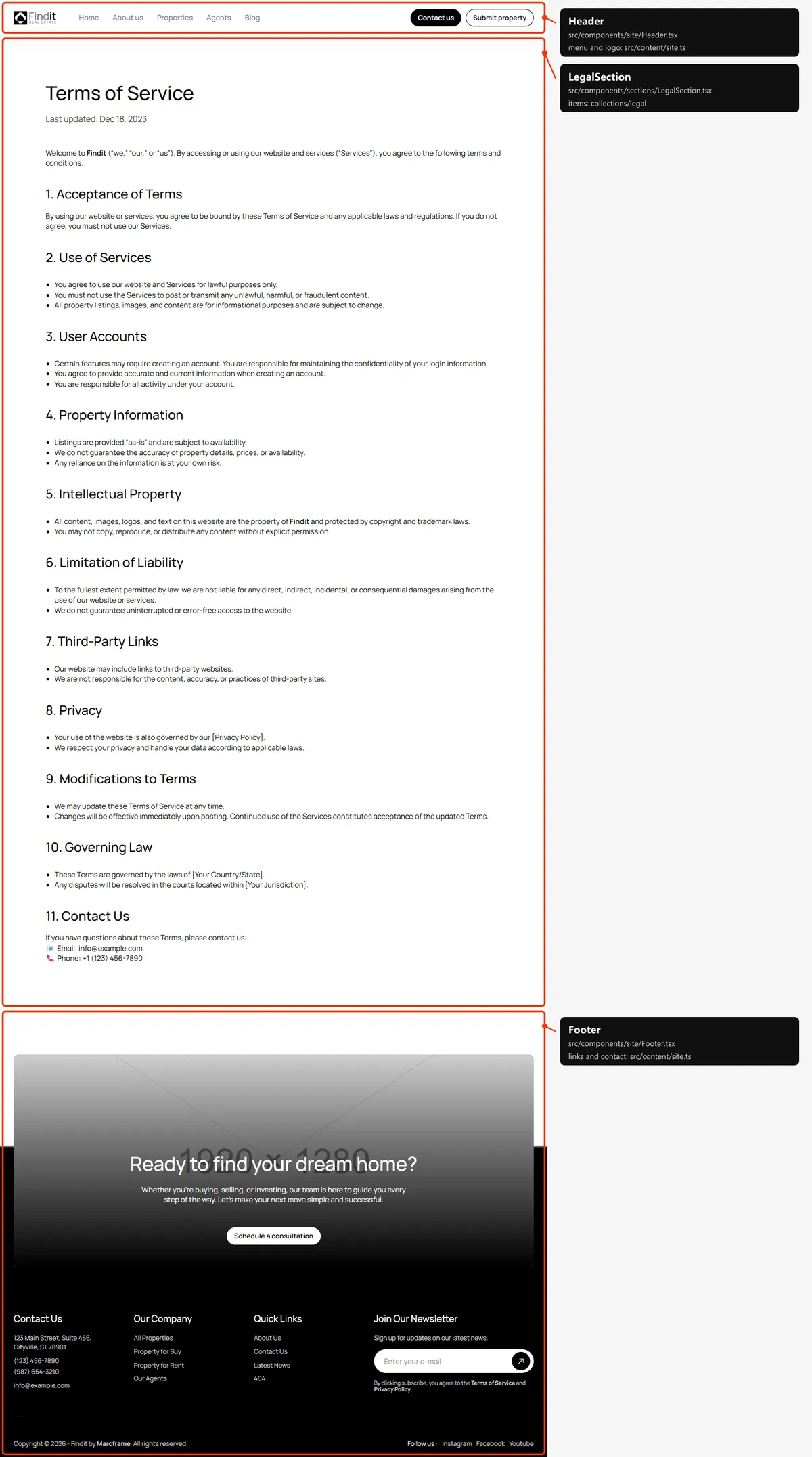
LegalSection |
Terms of Service, Privacy Policy |
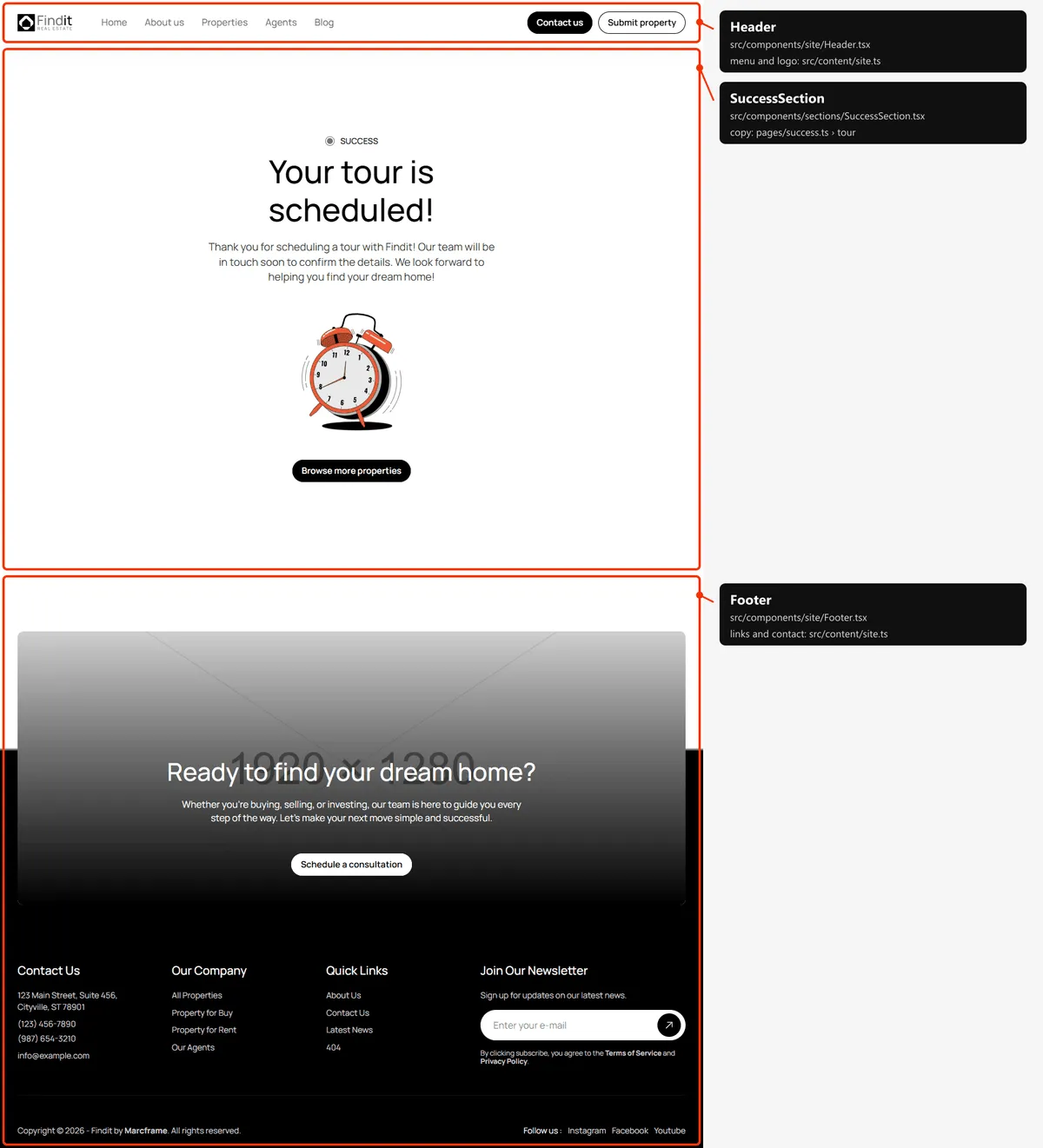
SuccessSection |
The two “thank you” pages |
NotFoundSection |
404 |
Copy that several pages share — benefits, process, latest properties, testimonials, facts and the FAQ — is in
src/content/sections.ts, so changing it once changes it everywhere it appears.
Page maps
Section titled “Page maps”Every page type with each section outlined and labelled: the component that renders it, the file to edit, and where
its copy (src/content/pages/*.ts) and items (src/content/collections/*.ts) come from. Header and footer take
their links and details from src/content/site.ts. Photos are the placeholders of the download.

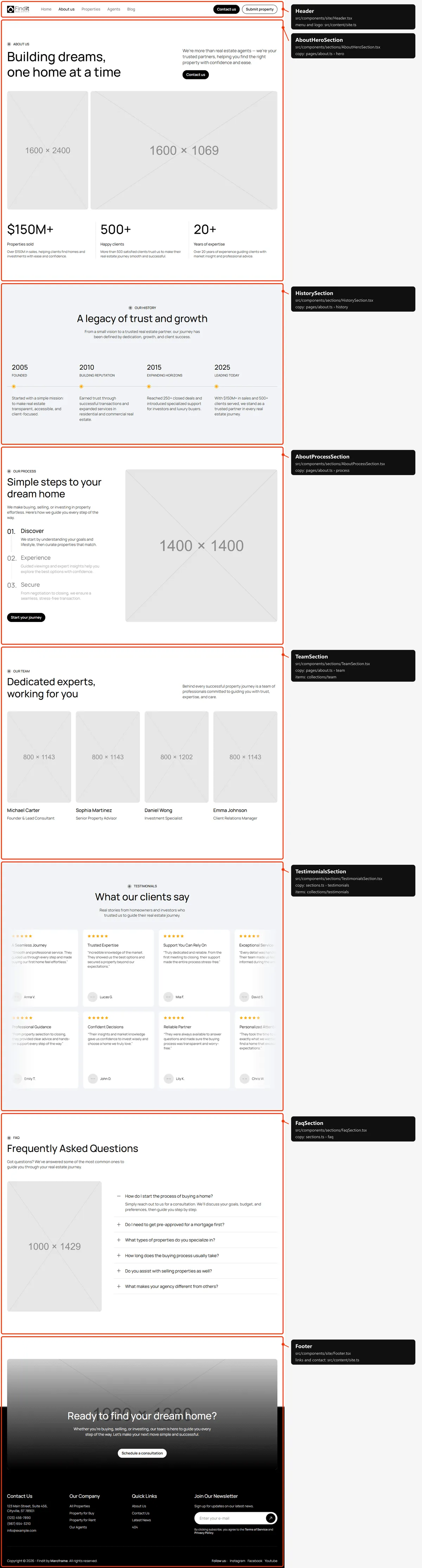
Properties
Section titled “Properties”The list, the three kinds of filter page (/filter/type/sell, /filter/type/rent, /filter/location/<slug>,
/filter/property-category/<slug>) and the location and category pages are this same layout with another list and title.
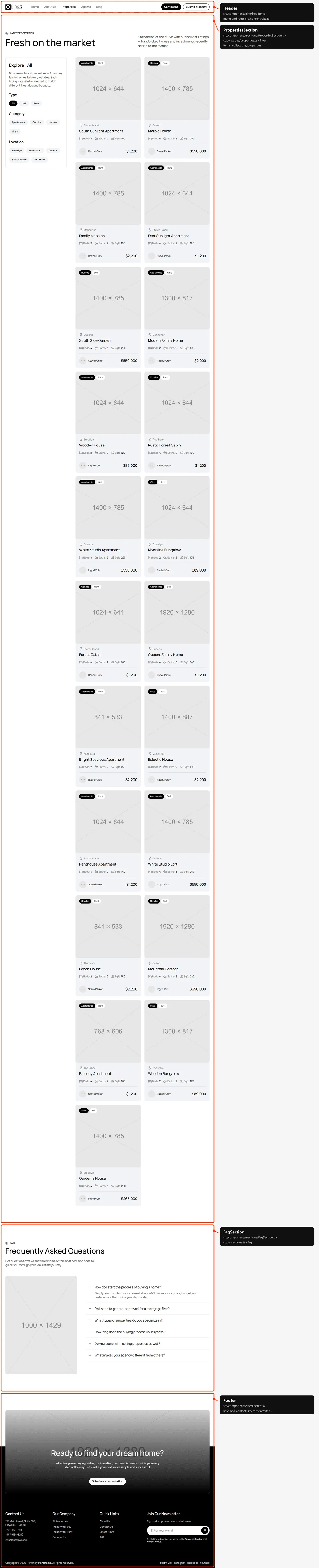
Property details
Section titled “Property details”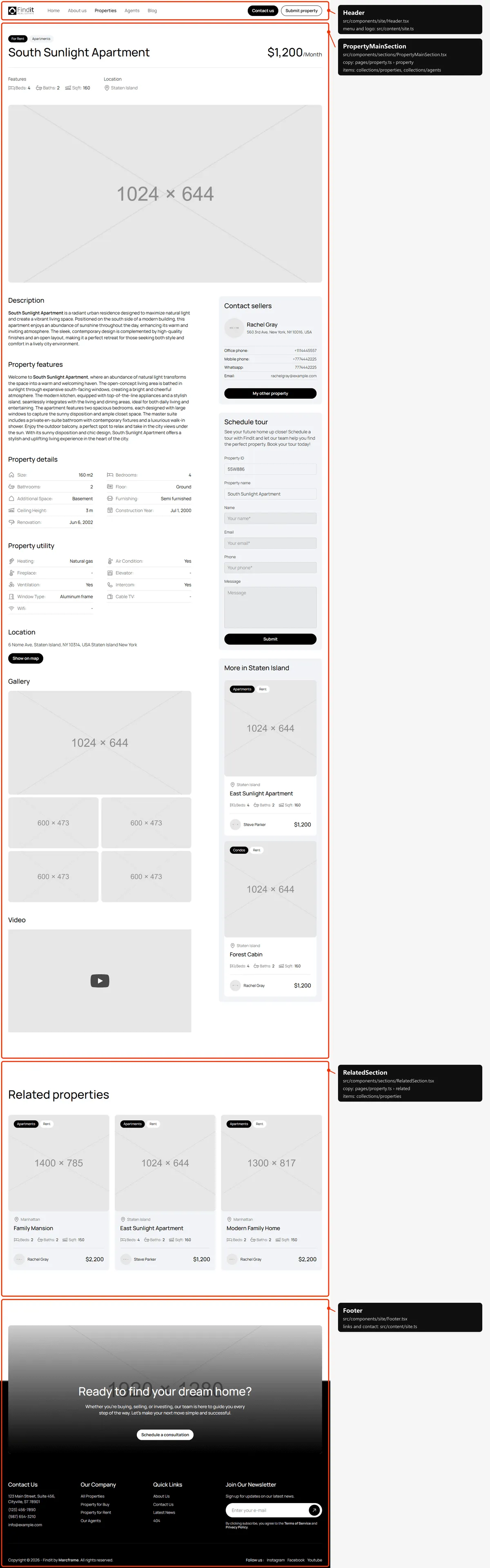
Agents
Section titled “Agents”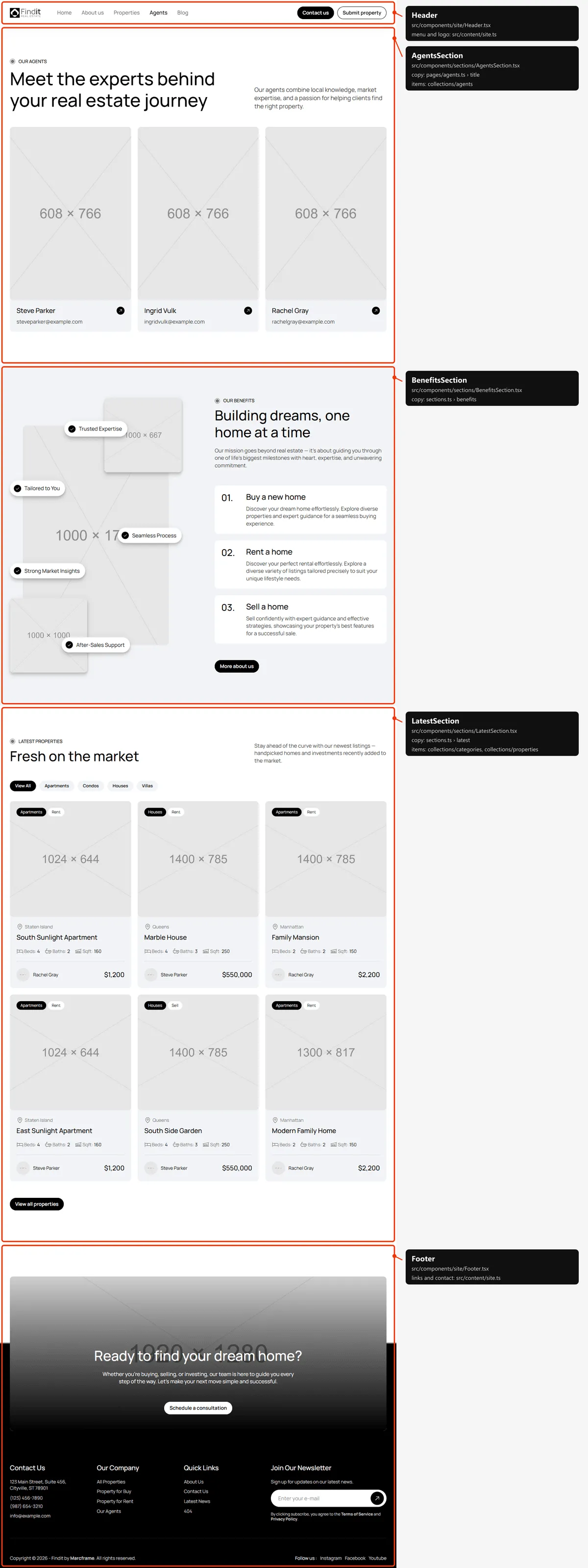
Agent details
Section titled “Agent details”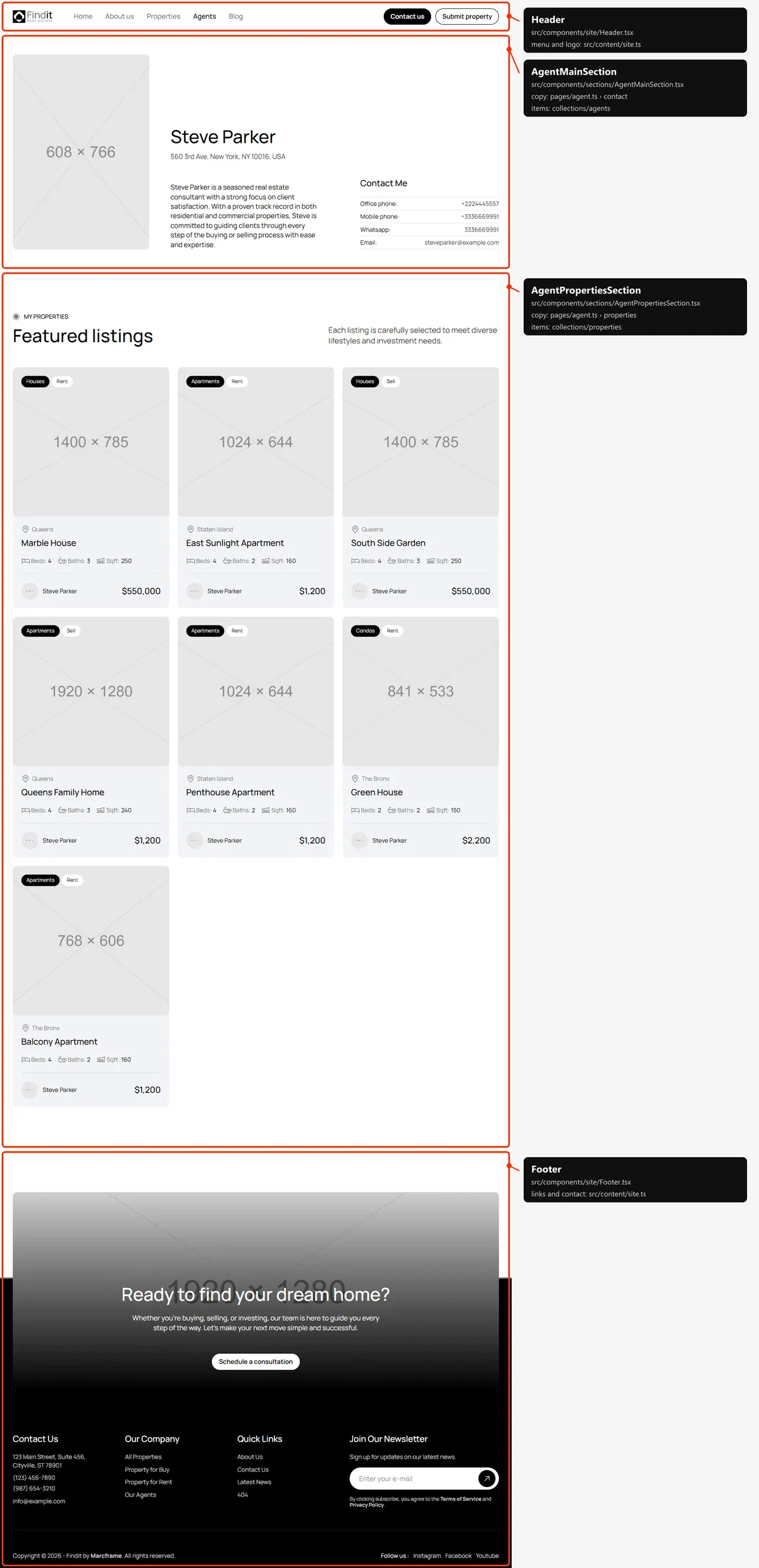
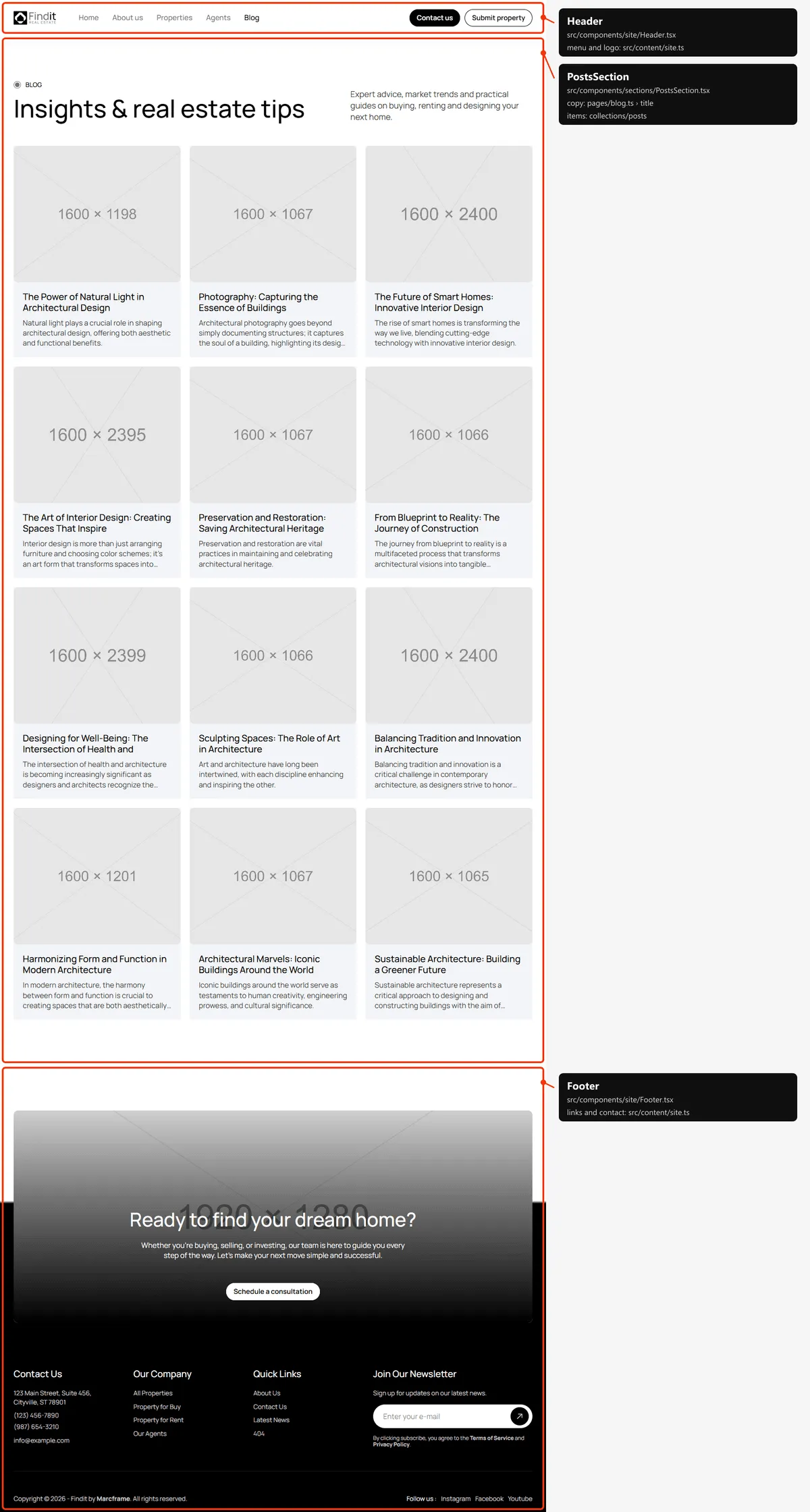
Blog post
Section titled “Blog post”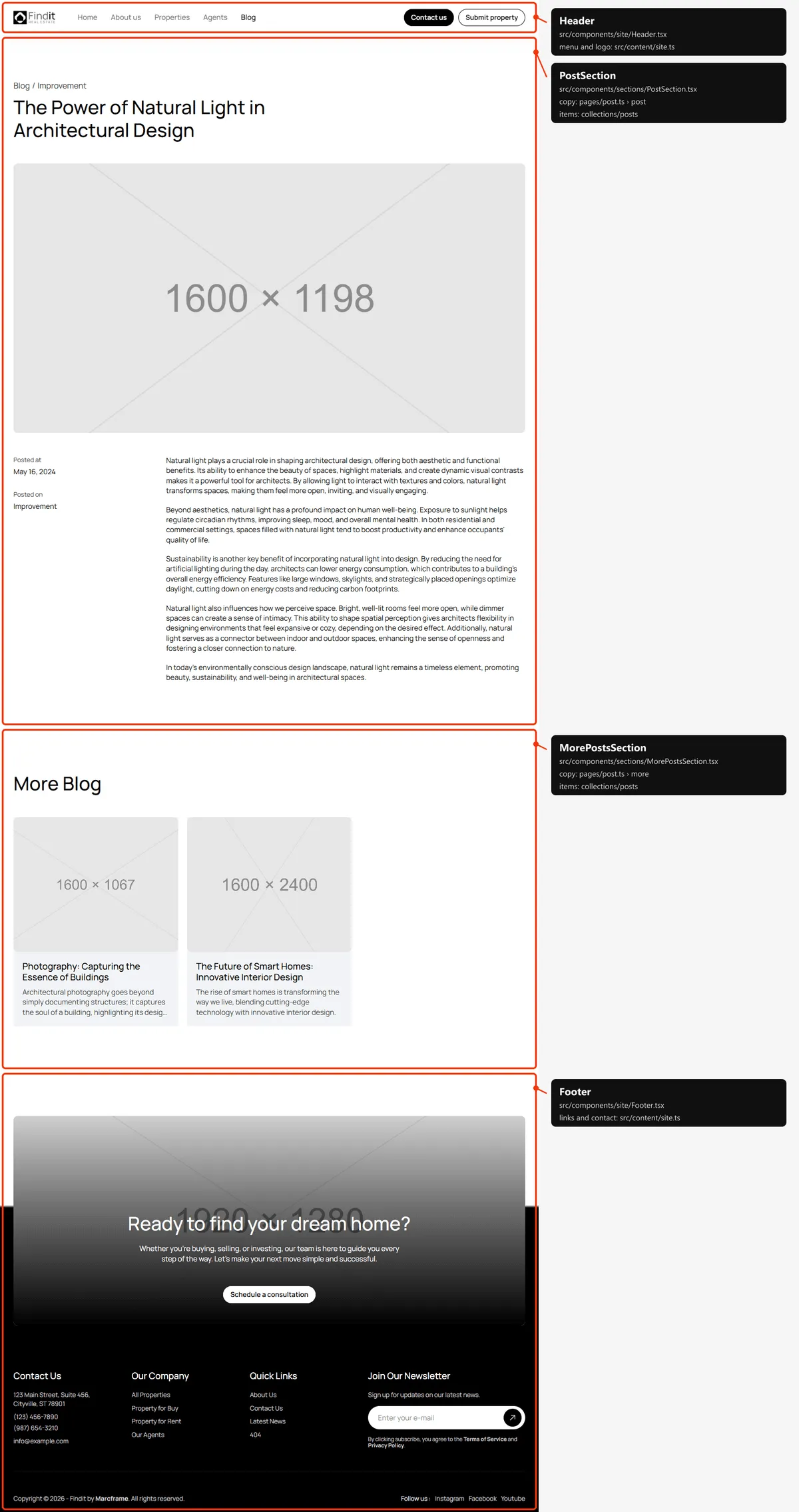
Contact
Section titled “Contact”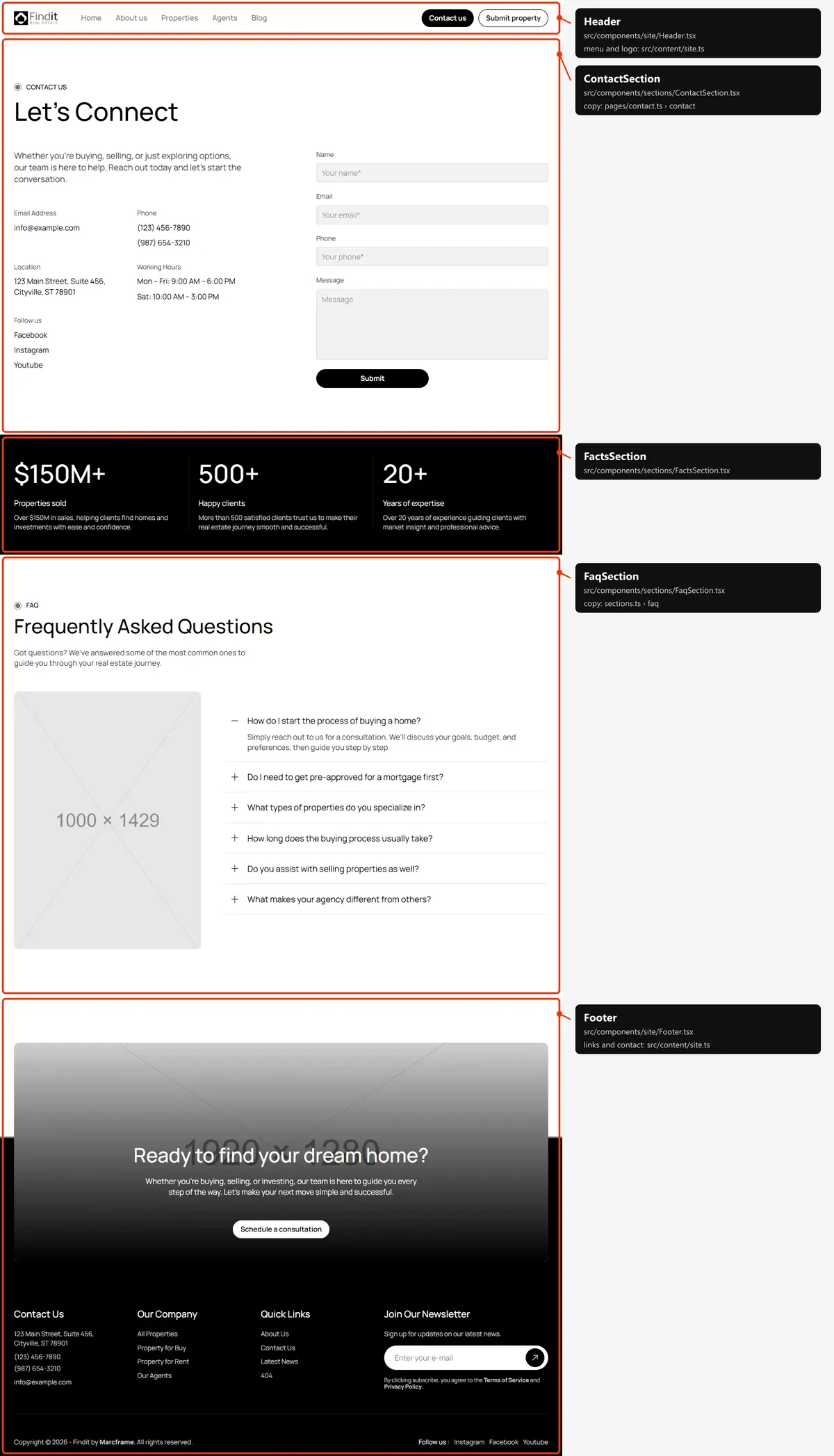
Add property
Section titled “Add property”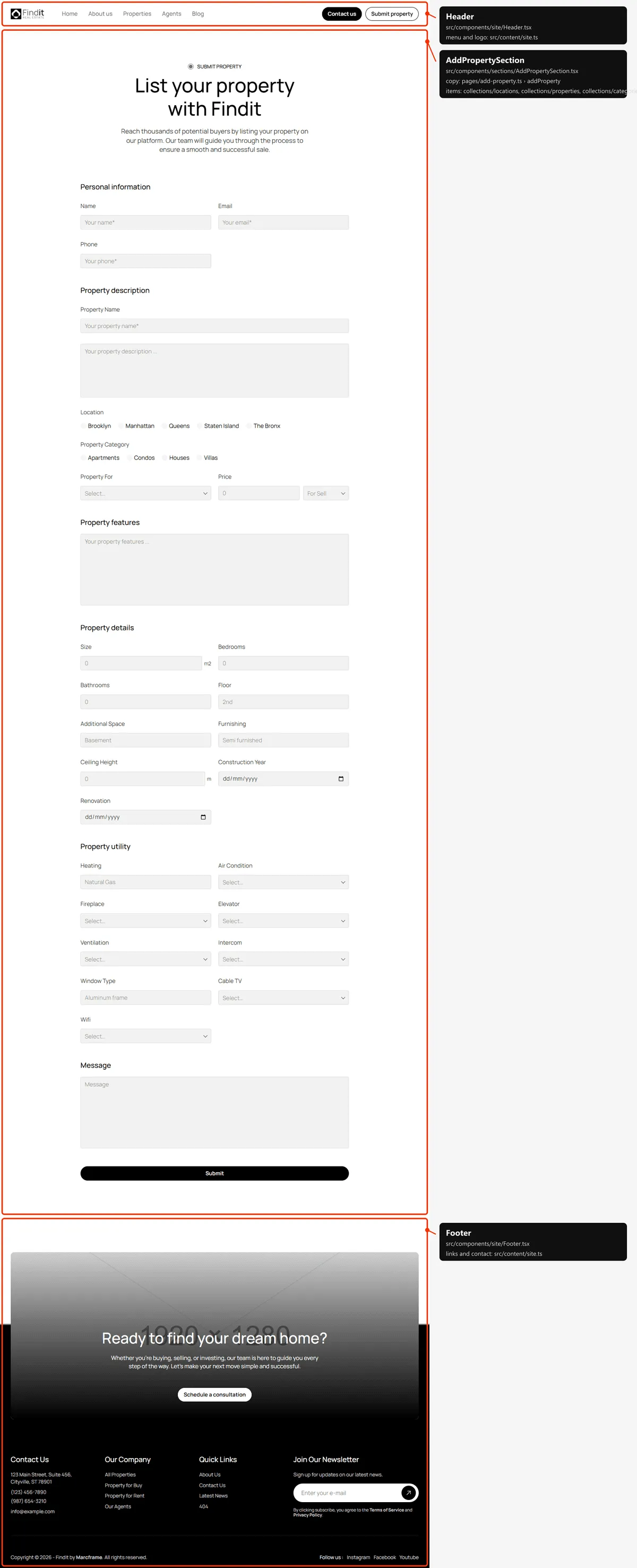
Thank you
Section titled “Thank you”Shown after “Schedule a tour” (/success/scheduled) and after “Add property” (/success/add-property), with the words
of src/content/pages/success.ts (tour and property).
Page not found
Section titled “Page not found”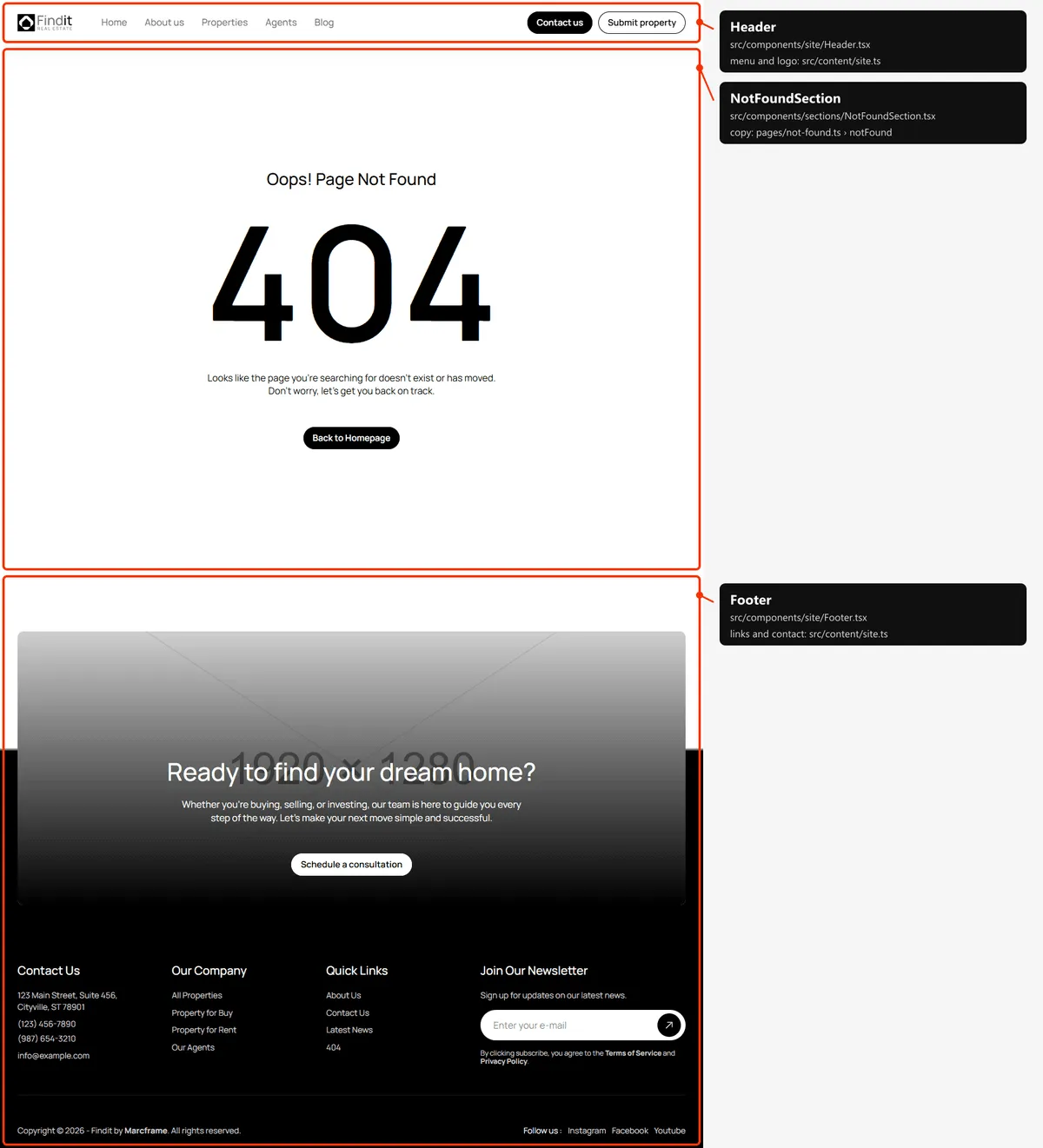
Filters
Section titled “Filters”The Properties page and its filter pages read getPropertyList() in src/lib/property-list.ts. It builds the chips
from the collections, so you never register a filter:
- Type — “Sell” or “Rent”, from each property’s
for. - Category and Location — every category and location that at least one property uses.
Each option is a page of its own (/filter/type/sell, /filter/location/brooklyn,
/filter/property-category/apartments) with its own title, description and canonical link, set in the meta of
src/content/pages/properties.ts. A location or category that no property uses keeps its page but is noindex and left
out of sitemap.xml, so search engines never list an empty result.
Reordering or removing a section
Section titled “Reordering or removing a section”Move the lines in the page file, or delete one. To take the testimonials off the home page, delete
<TestimonialsSection … /> from src/app/page.tsx; its copy in src/content/sections.ts can stay or go.
Adding a page
Section titled “Adding a page”- Add the URL to
src/content/routes.ts:pricing: "/pricing", - Add its copy to
src/content/pages/pricing.ts, with ameta(title, description):export const pricing = {meta: { title: "Pricing", description: "What it costs to list a property with us, in plain numbers." },cta: { … },}; - Create
src/app/pricing/page.tsx:import type { Metadata } from "next";import { FaqSection } from "@/components/sections/FaqSection";import { faq } from "@/content/sections";import { pricing } from "@/content/pages/pricing";import { routes } from "@/content/routes";import { pageMeta } from "@/lib/meta";export const metadata: Metadata = pageMeta(routes.pricing, pricing.meta);export default function PricingPage() {return <FaqSection content={faq} />;} - Link to it: add
{ label: "Pricing", href: routes.pricing }tonavigationinsrc/content/site.ts, or to the footer links. - Add it to
src/app/sitemap.ts, next to the other top-level pages.
Removing a page
Section titled “Removing a page”Delete its folder under src/app/, its entry in navigation and in src/app/sitemap.ts, and the route in
routes.ts. npm run build then tells you about anything still linking to it through routes.
Pages built from a collection
Section titled “Pages built from a collection”src/app/blog/[slug]/page.tsx builds one page per post:
export const dynamicParams = false; // only the slugs below exist; anything else is a 404export async function generateStaticParams() { return (await getPosts()).map((post) => ({ slug: post.slug }));}Add a post to src/content/collections/posts.ts and its page, its links and its sitemap entry appear on the next
build. The same pattern builds the property, agent and legal pages.
The 404 page
Section titled “The 404 page”src/app/not-found.tsx, with its copy in src/content/pages/not-found.ts. It is noindex, like the style guide and the
two “thank you” pages.
Search engines
Section titled “Search engines”src/app/sitemap.tsbuildssitemap.xmlfromroutes.tsand the collections, so new items list themselves. The thank-you pages, the 404 page and empty filter pages are left out.src/app/robots.tsbuildsrobots.txtand points at the sitemap. Both usesite.url, so set your domain before publishing.- Every indexable page gets a title, a description, a canonical link, an
og:urland a share image frompageMeta(src/lib/meta.ts). A title that would be longer than 60 characters with| Finditappended is shown without the suffix. noindexpages: the style guide, both thank-you pages, the 404 page and any filter page without properties.