Pages and sections — Fitbricks HTML
Fitbricks has 16 kinds of page and 103 addresses in its sitemap; each page is one HTML file whose <main> holds its
sections, top to bottom.
This guide lists every kind of page with its sections, says where its words and photos are, and explains how the pages link to each other, the header and what search engines see. To change a section, find its words in the file and edit them there (Editing the site).
The pages
Section titled “The pages”| Page | File | Sections in <main> |
|---|---|---|
| Home | index.html |
11 |
| About | about.html |
6 |
| Programs | program.html |
2 |
| Program (one per program) | program/<slug>.html (20) |
3 |
| Program category (one per category) | program-category/<slug>.html (5) |
2 |
| Clubs | club.html |
3 |
| Club (one per club) | club/<slug>.html (30) |
2 |
| City (one per city) | city/<slug>.html (10) |
3 |
| Trainers | trainer.html |
2 |
| Trainer (one per trainer) | trainer/<slug>.html (12) |
3 |
| Free Trial | free-trial.html |
1 |
| Contact | contact.html |
3 |
| Blog | blog.html |
1 |
| Post (one per post) | blog/<slug>.html (16) |
2 |
| Legal page | legal/privacy-policy.html, legal/terms-conditions.html |
1 |
| Page not found | 404.html |
1 |
Every page also has the header and the footer, copied into each file. Photos are in assets/images/, named after their
place (program-<slug>.jpg, club-<slug>.jpg, trainer-<slug>.jpg, post-…); Editing the site lists
them with their sizes. The style guide (style-guide.html) is a page of its own, linked from nowhere.
In the HTML files a section is a <section> directly inside <main>: count them from the top. The maps below outline
each one and name it, with the file that holds it in the Astro edition (src/components/…, its copy in pages/…json or
site.json, the items it lists in collections/…); in this edition the box is simply the matching <section> of the
page file, and its text is in the HTML. The photos in the maps are the download’s placeholders.

Eleven sections, top to bottom: the hero (a full-screen photo under the clear header, the eyebrow, the title and lead that rise in word by word, “Start Your Free Trial” and “Visit us”, and members’ quotes that turn every 4 seconds); the facts; the memberships (the text and four feature blocks); the clubs (the first six clubs); personal coaching (four goals); the promotion of the Pilates Reformer class; the programs (the first six programs); members’ stories (a ticker on desktop, a carousel with arrows below); the app’s features with the store badges; the blog (the six newest posts); the CTA band.
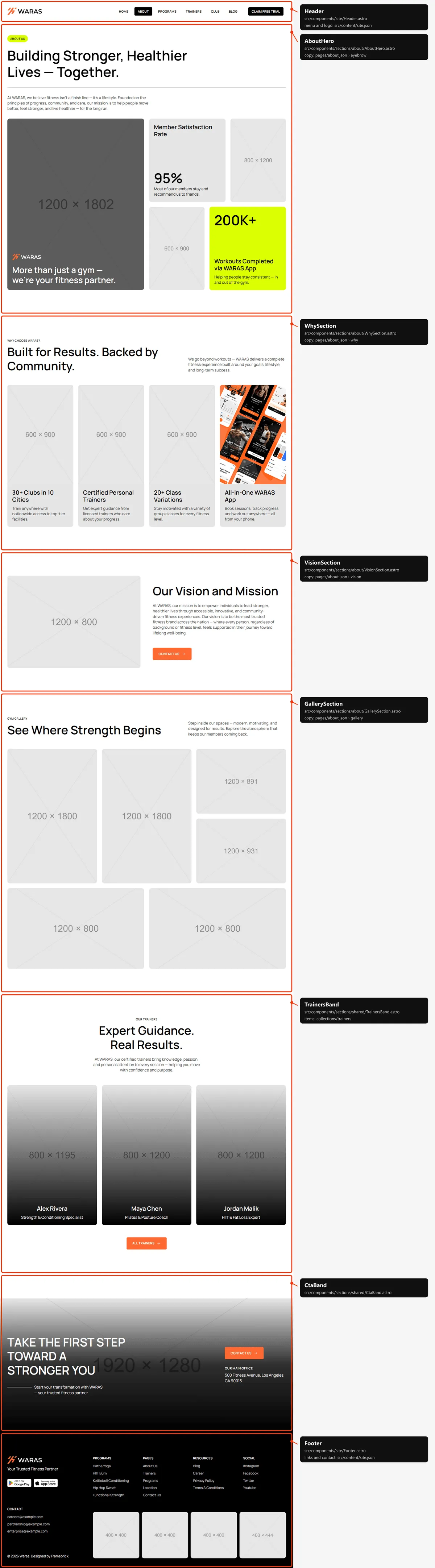
Six sections: the hero (the eyebrow, the title, the lead, a photo with the logo and the statement, and the facts); “Why Choose WARAS?” (three reasons with photos); “Our Vision and Mission”; the gym gallery with its Instagram chips; the trainers band (the first three trainers); the CTA band.
Programs
Section titled “Programs”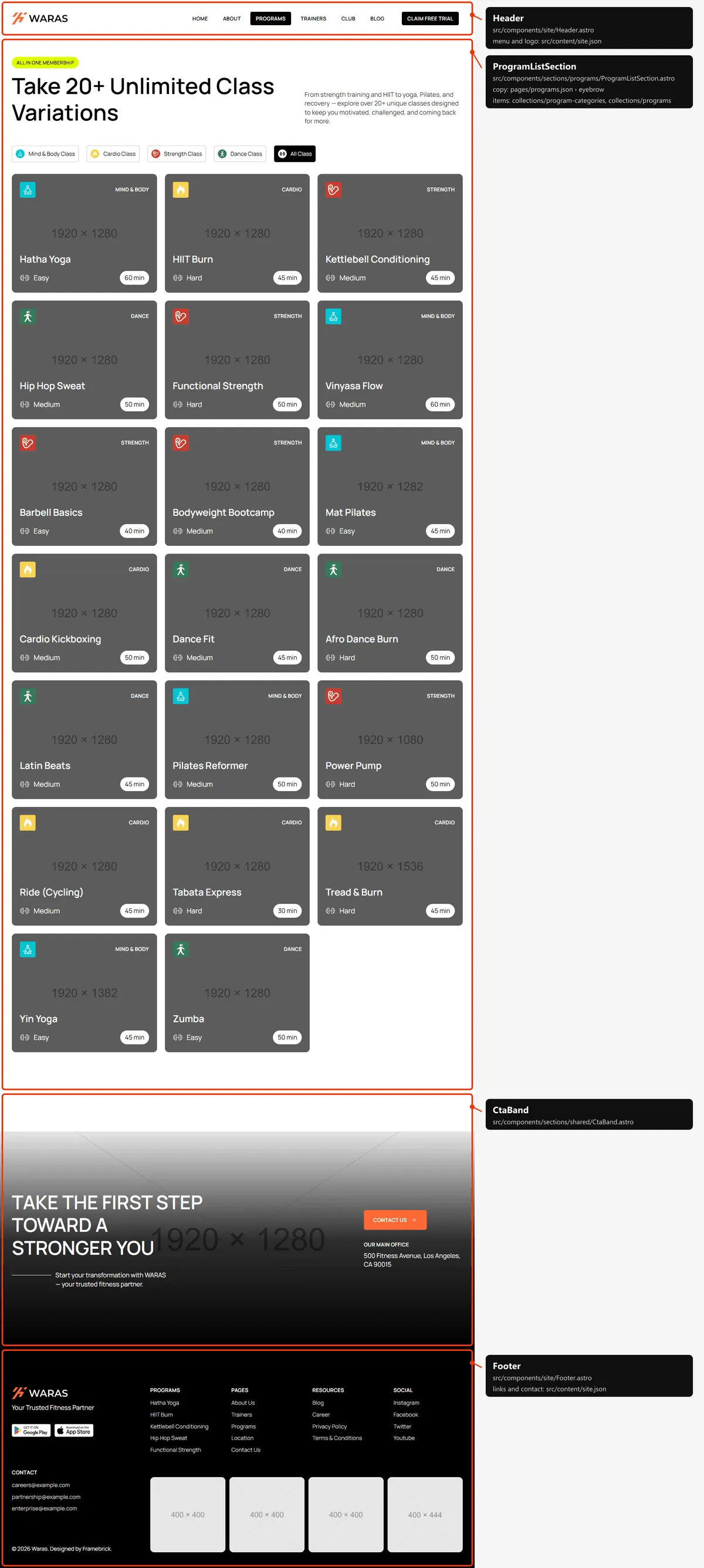
Two sections: the program list (the eyebrow, the title, the text, the category filter with “All Class” current, and every
program as a card: its photo, category, name, level and duration); the CTA band. Six cards show at first, and six more
appear each time the end of the list comes into view (data-page-size="6" on the list). Every card is in the HTML, so
search engines find them all, and visitors without JavaScript see them all at once.
Program
Section titled “Program”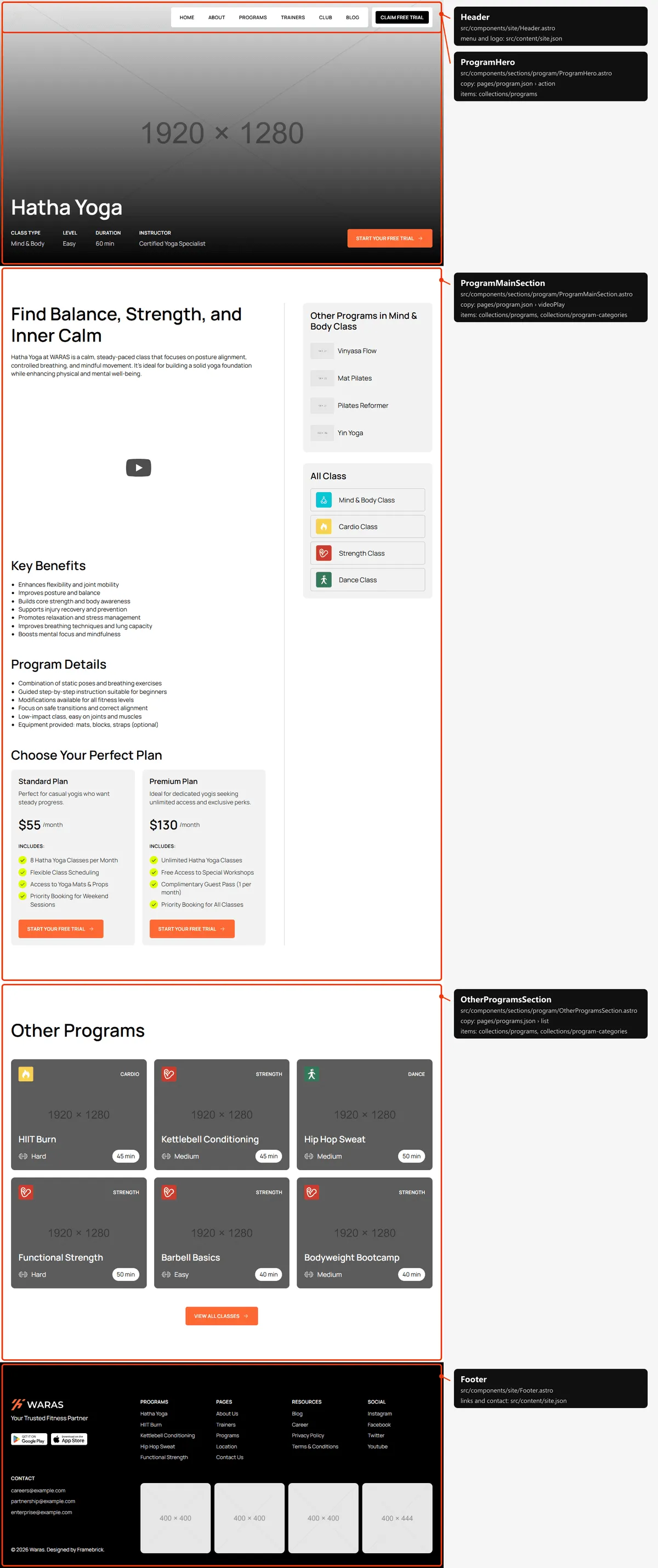
Three sections: the cover (the photo under the clear header, the name, Class Type, Level, Duration, Instructor and “Start Your Free Trial”); the main block (the subtitle, the text, the video, Key Benefits, Program Details and “Choose Your Perfect Plan” with two plans, beside a sidebar with the other programs of its category and the “All Class” list of categories); “Other Programs” (the first six programs of the other categories). The page has no CTA band.
Program category
Section titled “Program category”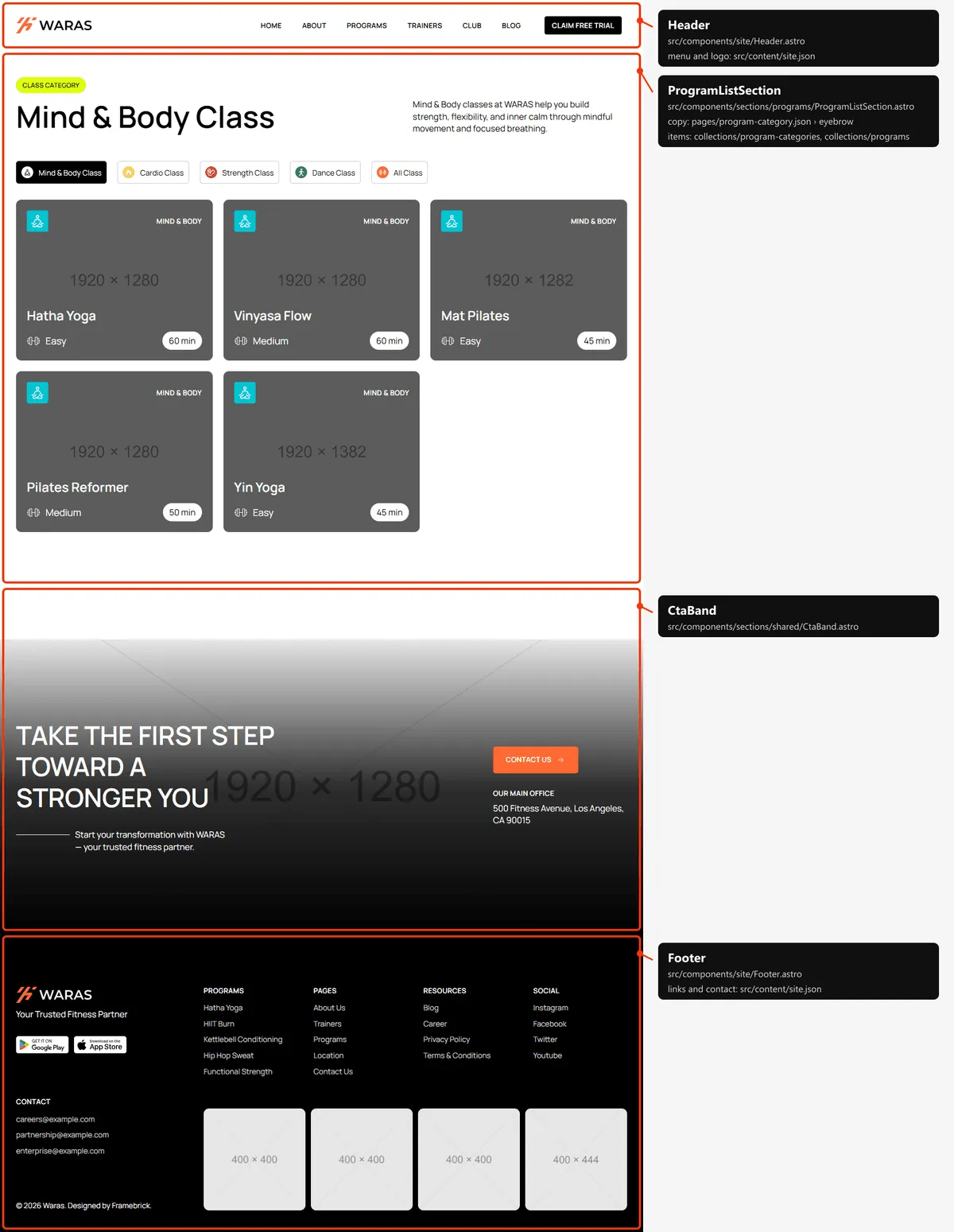
Two sections: the same list as Programs for one category (“Cardio Class”: its description, the filter with the category
current, its programs); the CTA band. program-category/default.html (“Default Class”) has no programs and no link in
the filter, as in the original design: its page shows the title, the text and the filter only.
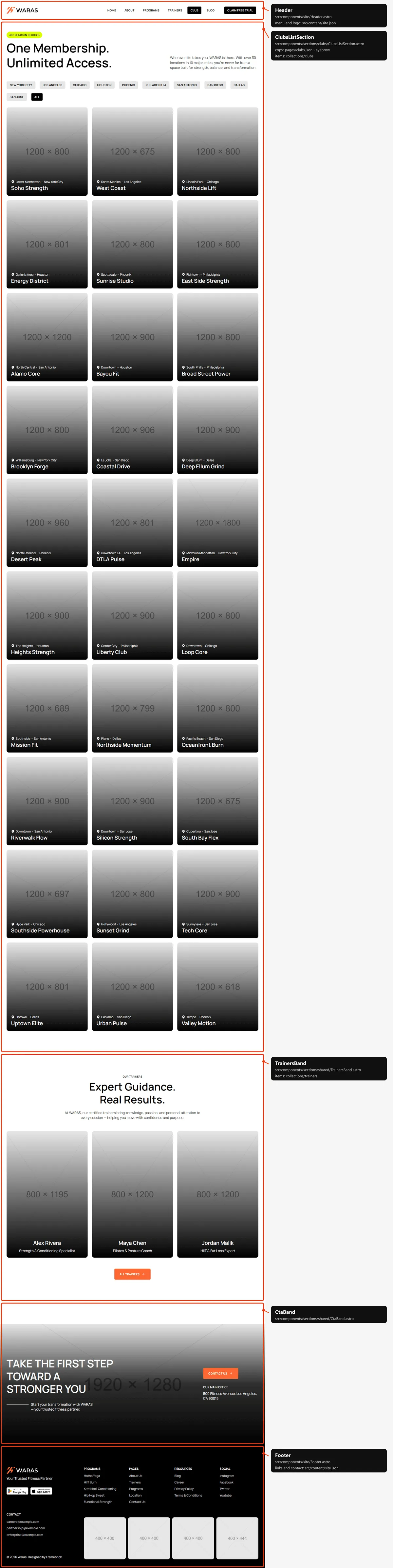
Three sections: the club list (the eyebrow, the title, the text, the city filter with “All” current, and every club as a card: its photo, area, city and name, six at a time as the visitor scrolls); the trainers band; the CTA band.
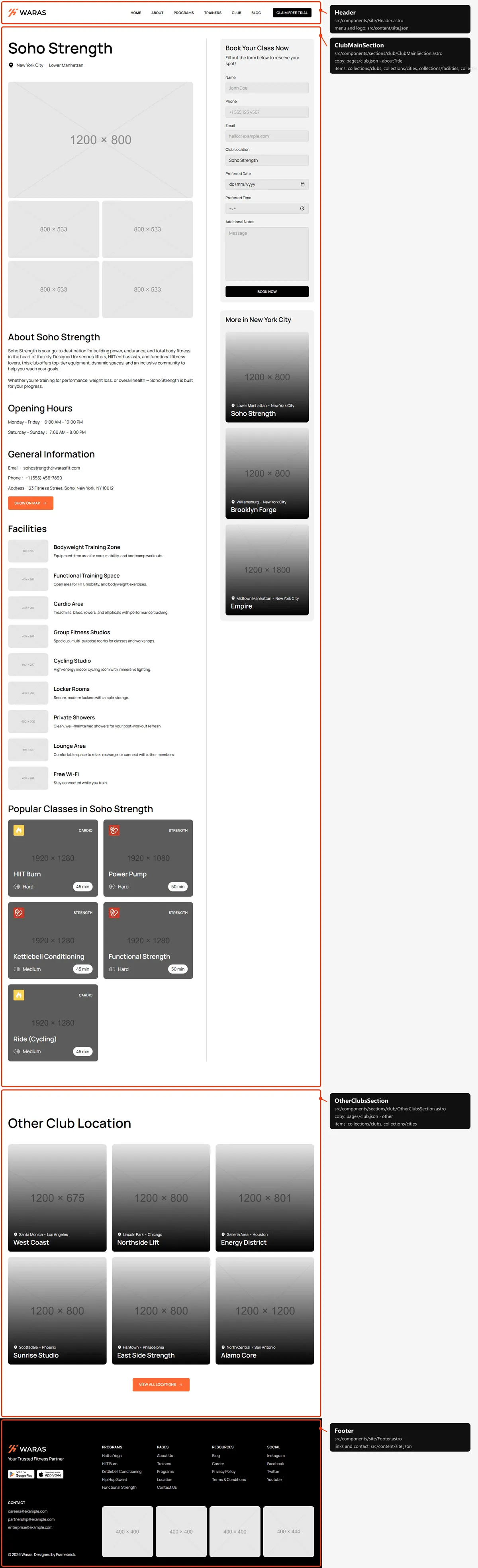
Two sections: the main block (the name with its city and area, the main photo and four gallery photos, About, Opening Hours, General Information with “Show on map”, Facilities and Popular Classes, beside a sidebar with the booking form and “More in” its city); “Other Club Location” (the first six clubs of the other cities) and “View all locations”. The page has no trainers band and no CTA band.
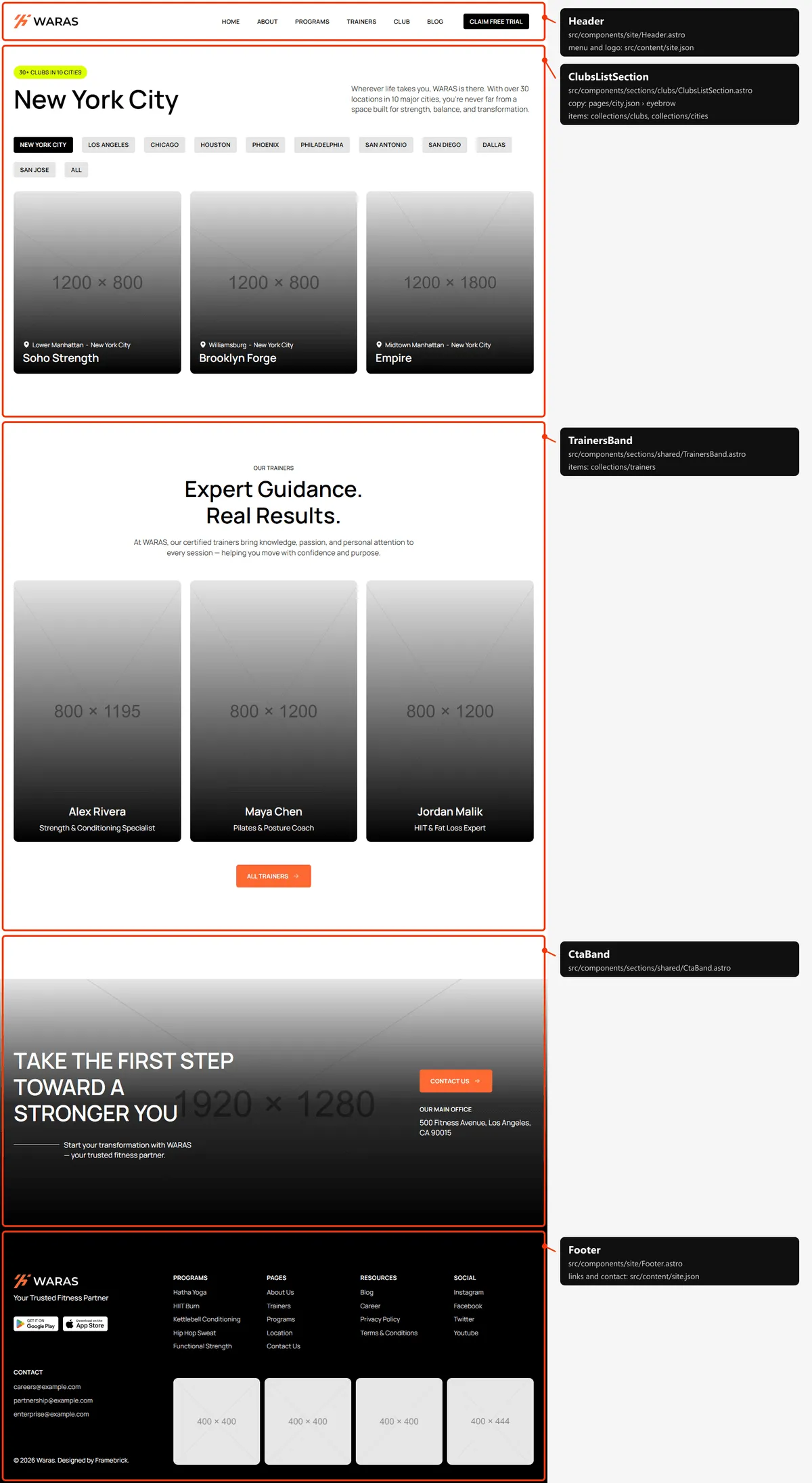
Three sections: the Clubs list for one city (the city’s name as the title, the filter with the city current, its clubs); the trainers band; the CTA band. The eyebrow and the text are the same on every city.
Trainers
Section titled “Trainers”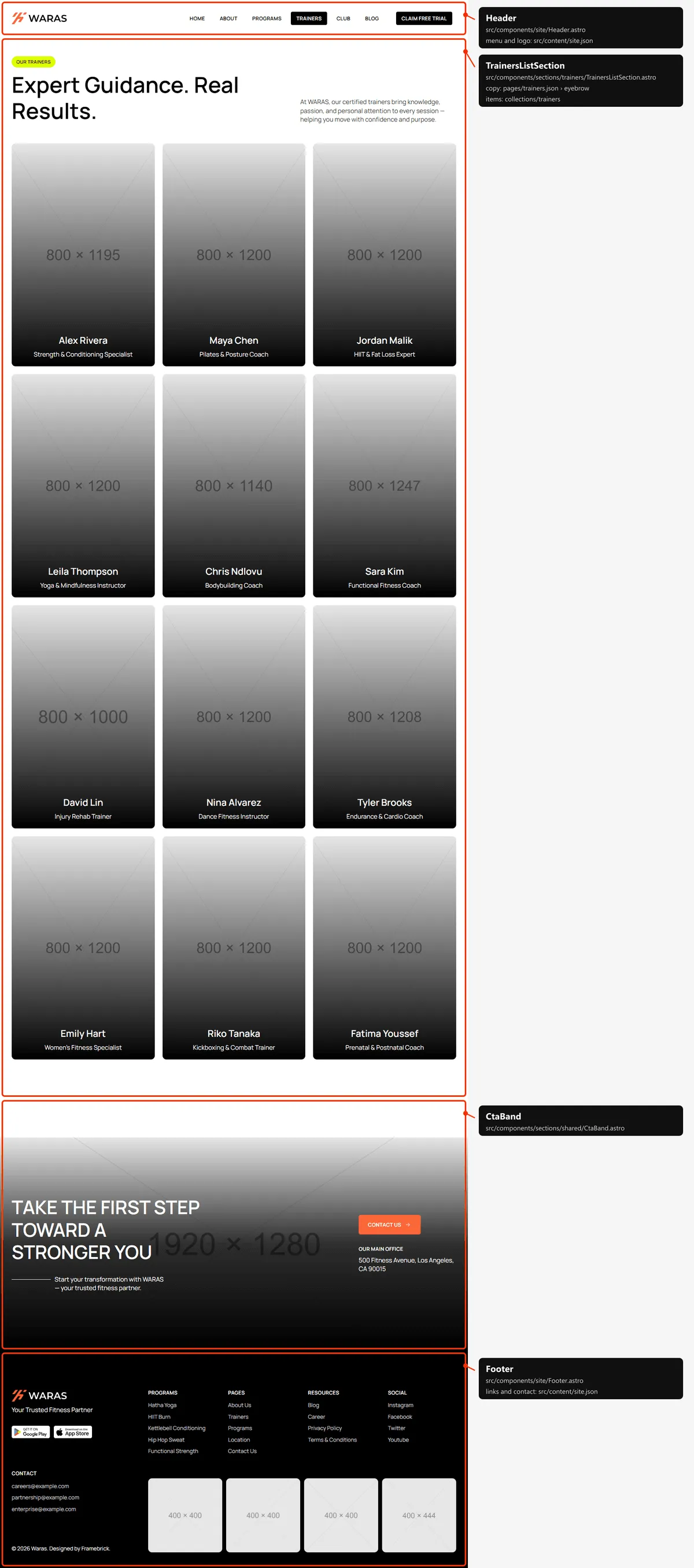
Two sections: the trainer list (the eyebrow, the title, the text and every trainer as a card: portrait, name, title, summary and “See Details”; six at a time on desktop, four on tablets and phones); the CTA band.
Trainer
Section titled “Trainer”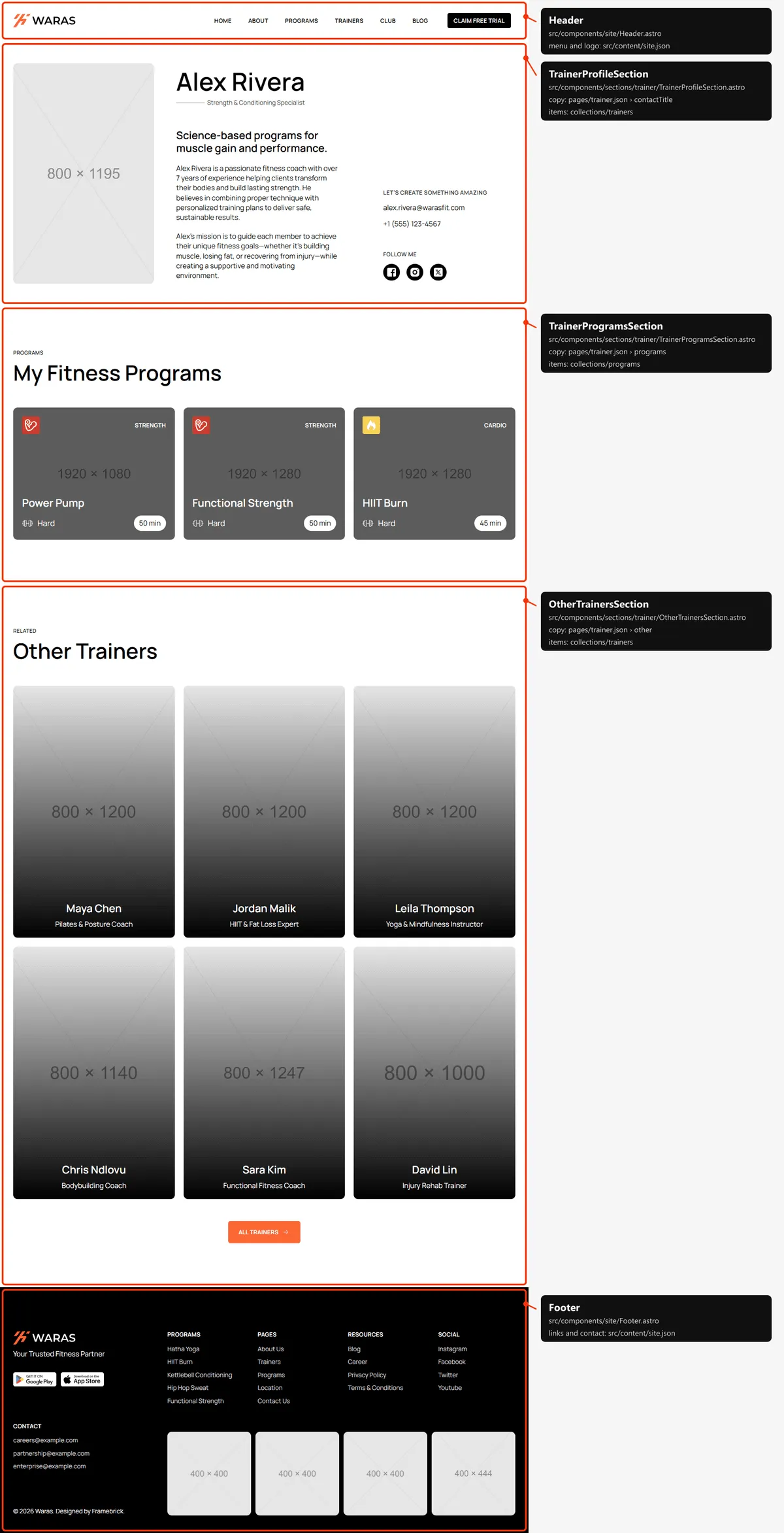
Three sections: the profile (portrait, name, title, summary, the about text, “Let’s Create Something Amazing” with the e-mail and phone, “Follow me” with the social links); “My Fitness Programs” (the programs they teach); “Other Trainers” (six of the others, four below desktop).
Free Trial
Section titled “Free Trial”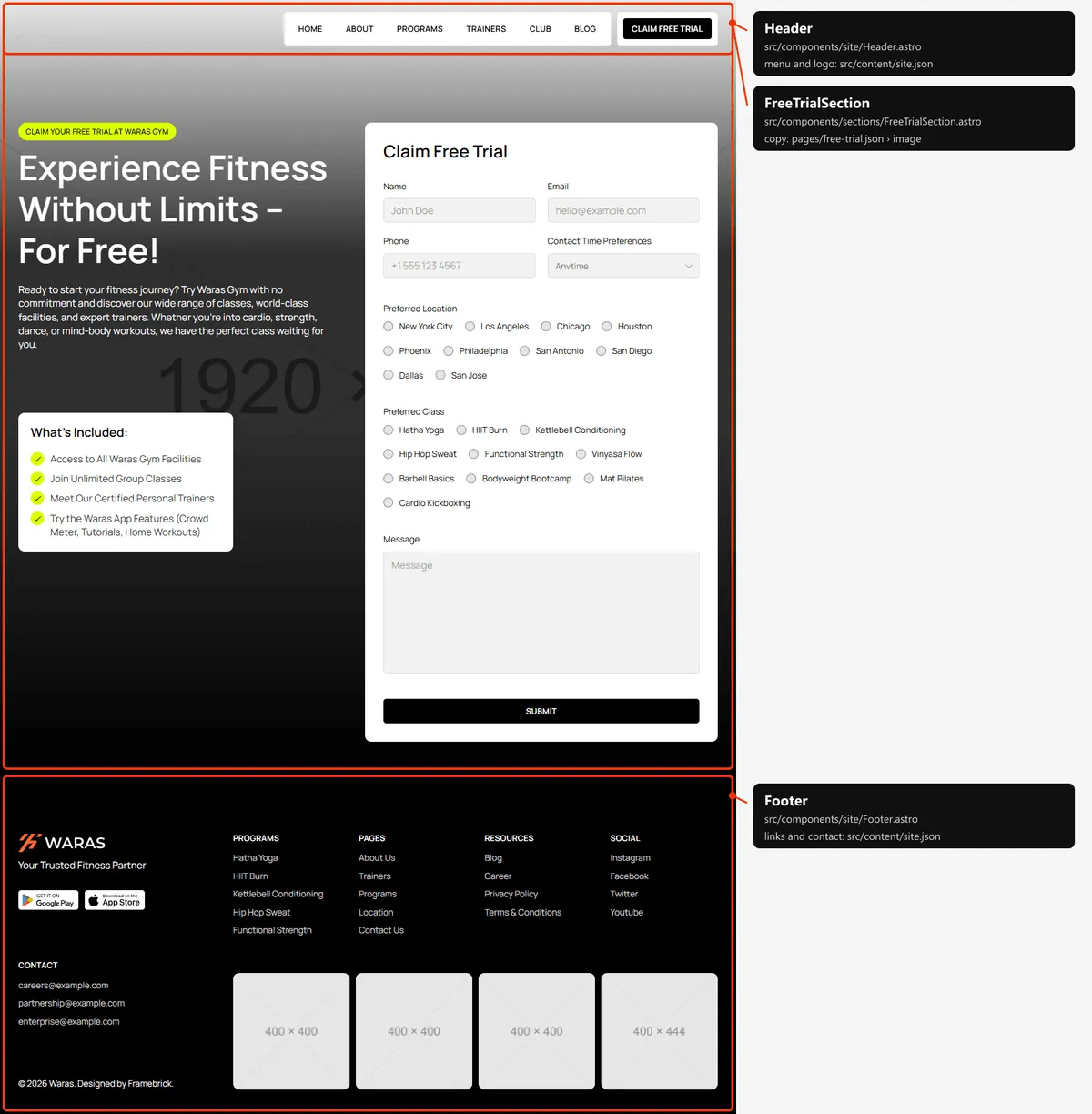
One section under the clear header: the photo, the eyebrow, the title, the text and “What’s Included”, beside the free-trial form with its two choices, Preferred Location (every city) and Preferred Class (the first ten programs) (Forms).
Contact
Section titled “Contact”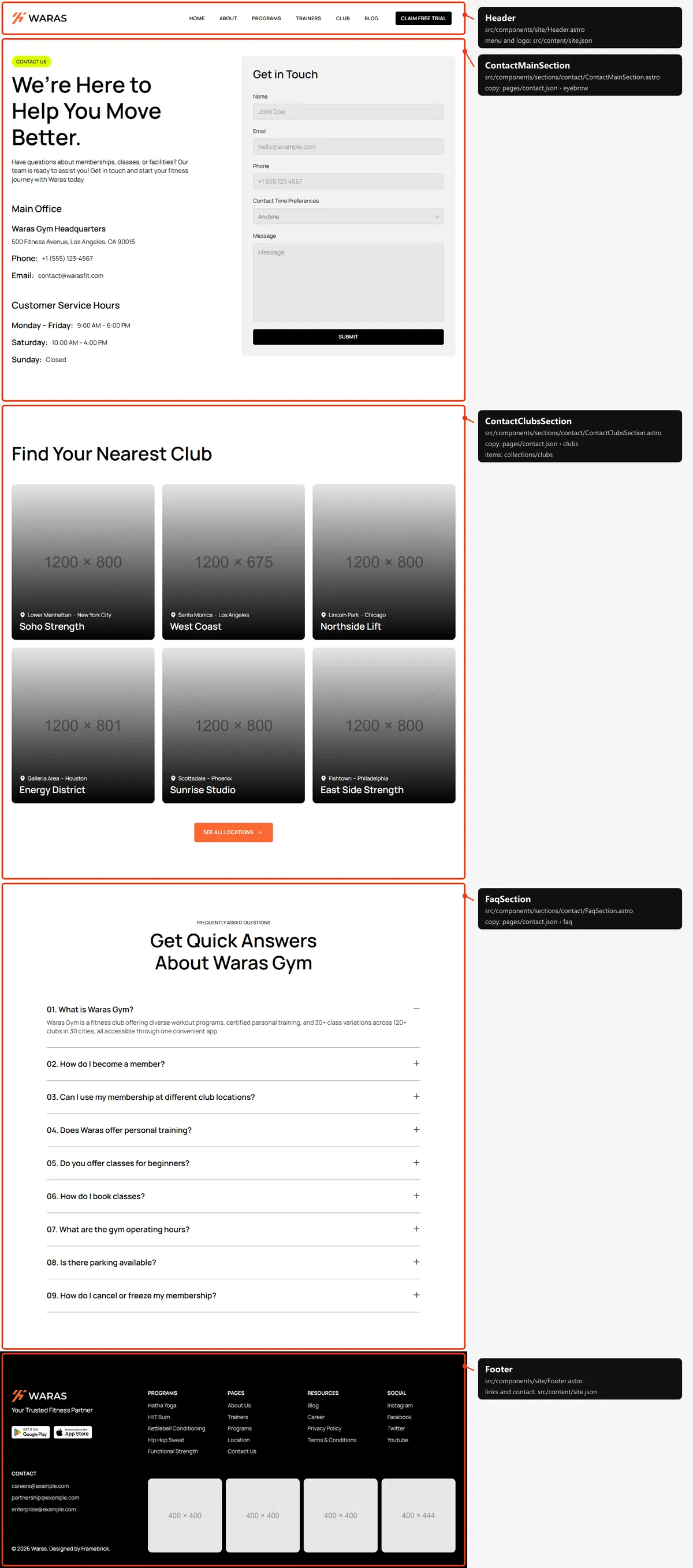
Three sections: the main block (the eyebrow, the title, the text, Main Office and Customer Service Hours beside the “Get in Touch” form); “Find Your Nearest Club” (the first six clubs) and “See all locations”; the FAQ (questions that open on click).
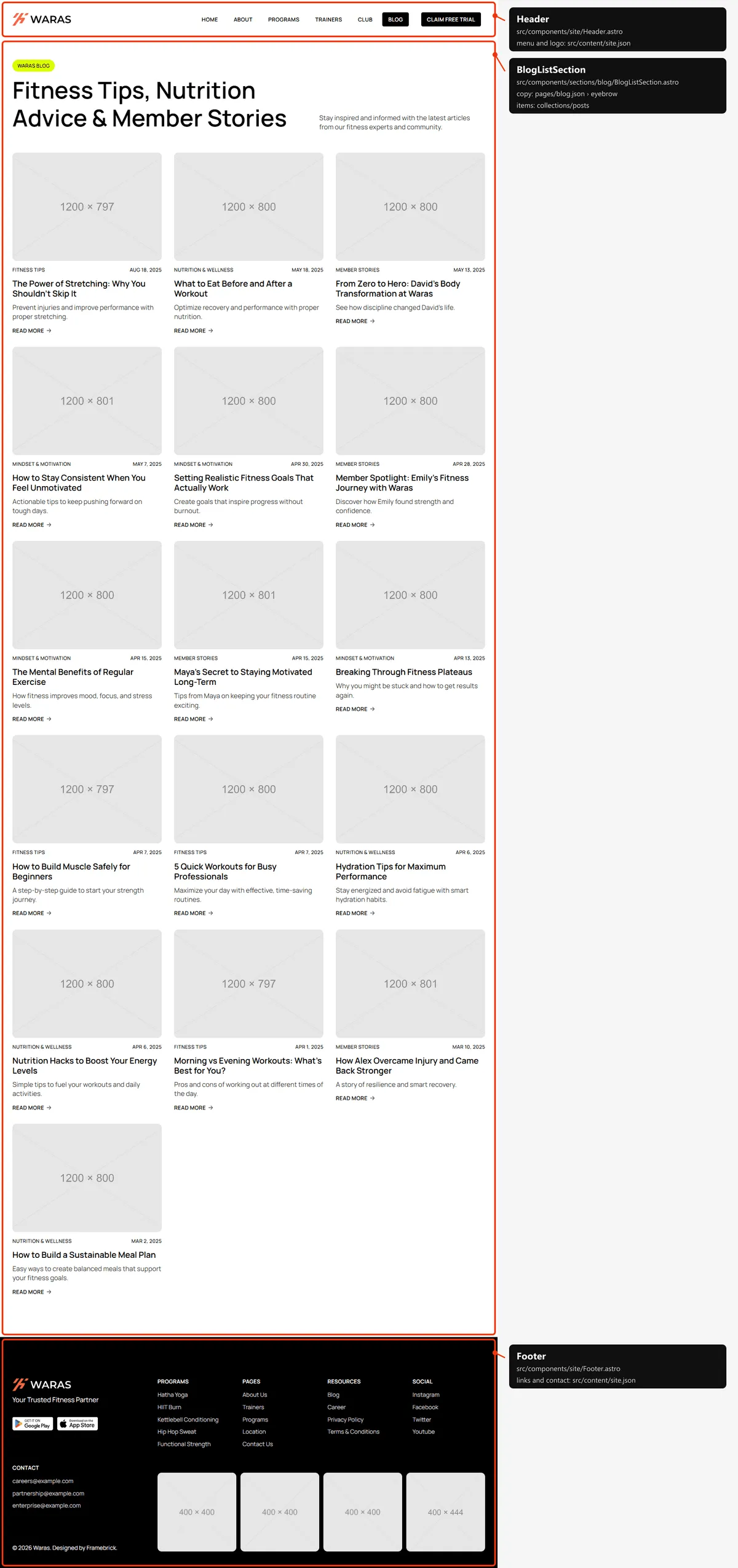
One section: the eyebrow, the title, the text and every post as a card, newest first (its photo, category, date, title,
excerpt and “Read more”). Five posts show at first, and five more each time the end of the list comes into view
(data-page-size="5").
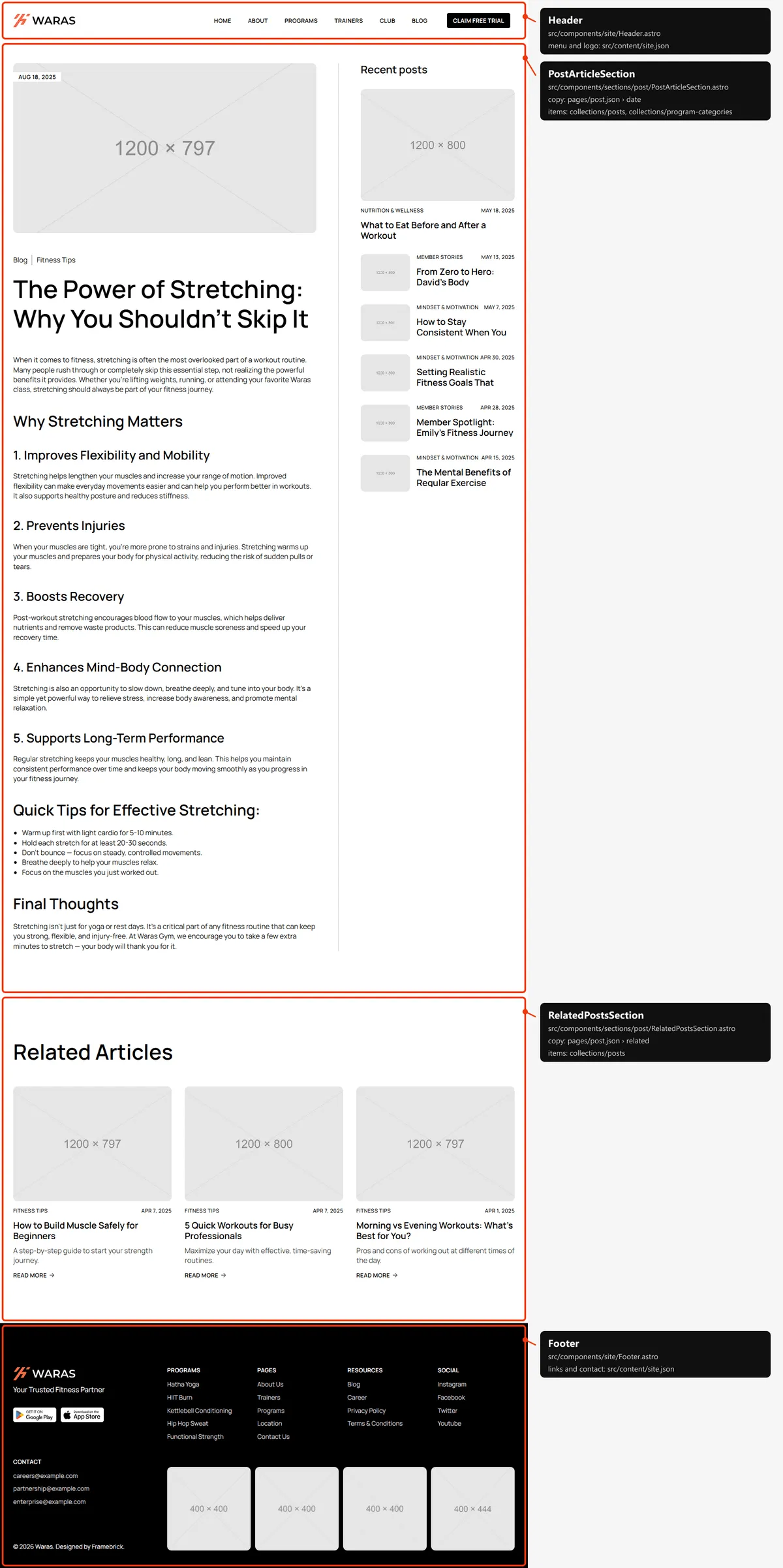
Two sections: the article (the cover, the date, a crumb back to Blog with the category, the title and the text, beside “Recent posts”, the six newest others); “Related Articles” (the newest other posts of its category).
Legal page
Section titled “Legal page”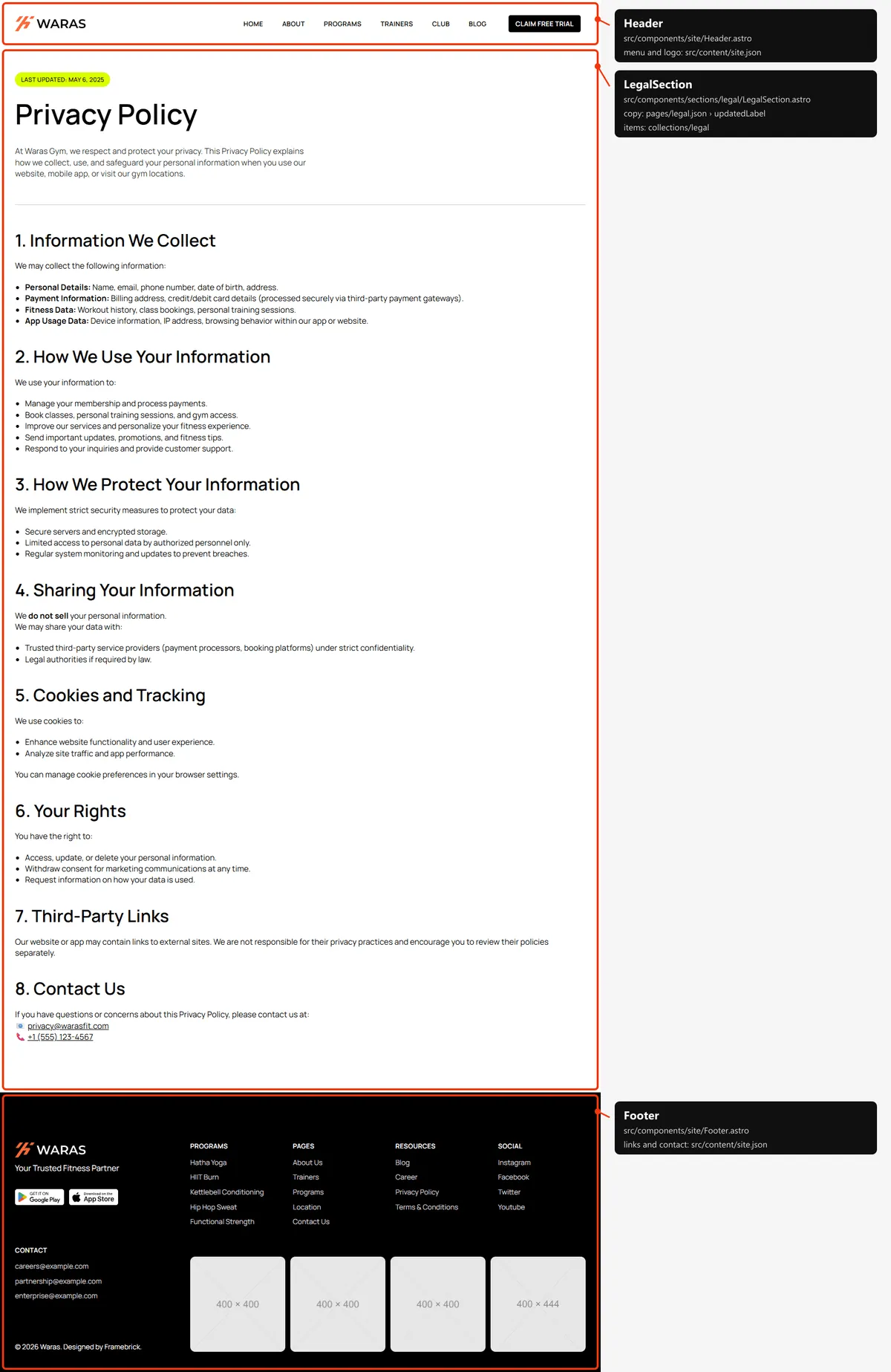
One section: “Last Updated:” with its date, the title, the lead and the text. Their texts are samples to replace (Editing the site).
Page not found
Section titled “Page not found”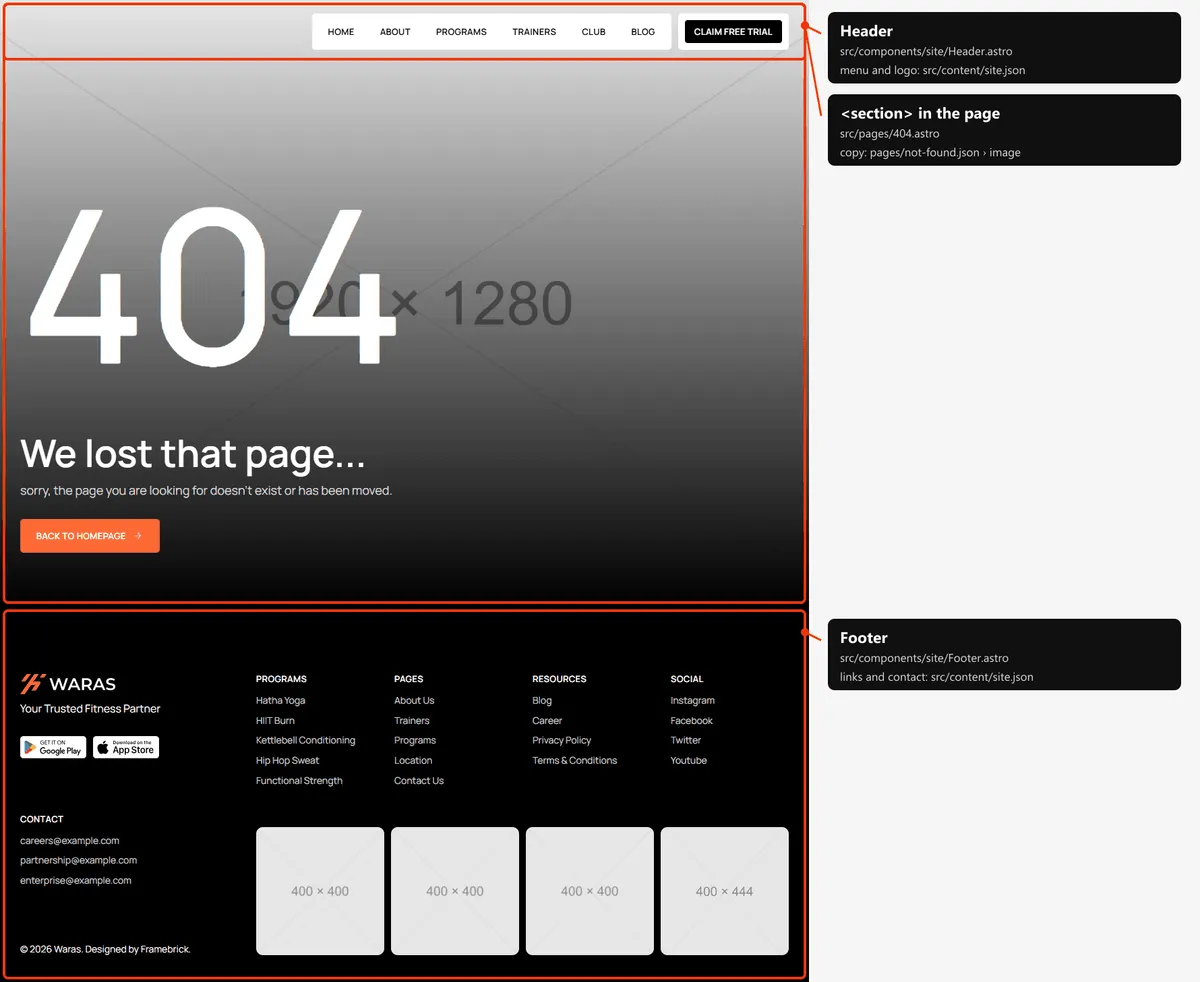
One block, a screen tall, under the clear header: a photo, the big “404”, a title, a line and “Back to Homepage”.
How the pages link to each other
Section titled “How the pages link to each other”The menu holds Home, About, Programs, Trainers, Club and Blog; the header’s button opens Free Trial (“Claim free trial”). The other pages are reached like this:
| Page | Linked from |
|---|---|
| A program | Its card everywhere (Home, Programs, its category page, the sidebar and “Other Programs” of the program pages, a club’s Popular Classes, a trainer’s programs) and the footer’s Programs column (the first five) |
| A program category | The category filter on Programs and the category pages, the “All Class” list of every program page, Home’s promotion (“Reserve your spot today”) |
| A club | Its card on Home, Clubs, its city’s page, Contact and the club pages (“More in”, “Other Club Location”) |
| A city | The city filter on Clubs and the city pages, the city’s name on a club page |
| A trainer | Its card on Trainers, the trainers band and “Other Trainers” |
| A post | Its card on Home, Blog, “Recent posts” and “Related Articles” |
| Free Trial | The header’s button, Home’s hero, a program’s cover and plans |
| Contact | “Contact us” in the CTA band, “Contact Us” on About and in the footer |
| Legal pages | The footer’s Resources column |
The header
Section titled “The header”- A bar fixed at the top of every page, 70 px tall on phones and 94 px from tablets up. On Home, the program pages,
Free Trial and the 404 page it is clear over the photo, with the white logo; elsewhere it is white with the black logo,
and
<main>leaves room for it. - Desktop: the logo, the menu links and “Claim free trial”. The current page’s link is filled black; on hover a link fills orange. Over a photo, the logo fades out as you scroll down and comes back as you scroll up. Tablet: the logo, “Claim free trial” and a “Menu” button. Phone: the logo and a menu button. The menu opens under the bar with the links and “Claim free trial”, turns the bar white, and closes when a link is followed or the visitor presses Escape. On tablets and phones the bar also turns white as you scroll down a page that starts with a photo.
Search engines
Section titled “Search engines”- Sitemap:
sitemap.xmllists Home, About, Programs, Clubs, Trainers, Free Trial, Contact, Blog, every program, program category, club, city, trainer and post, and the legal pages: 103 addresses. The 404 page and the style guide are left out. It is a plain file: add or remove a line when you add or remove a page, and put your domain in it. - Robots:
robots.txtallows everything and points at the sitemap; put your domain in itsSitemap:line. - Per page: every page has a title, a description, a canonical link, an
og:urland a share image in its<head>. Home’s title is “Fitbricks - Gym and Fitness Website”; the others end in| Fitbricks, unless that would make them longer than 60 characters. Programs, clubs, trainers and posts share their own photo; posts are shared as articles, with their date inarticle:published_time; every other page sharesopengraph-image.png. - Not indexed: the style guide (
noindex, nofollow) and the 404 page (noindex).